POSTWAR PARK AVENUE
1950s - 2000
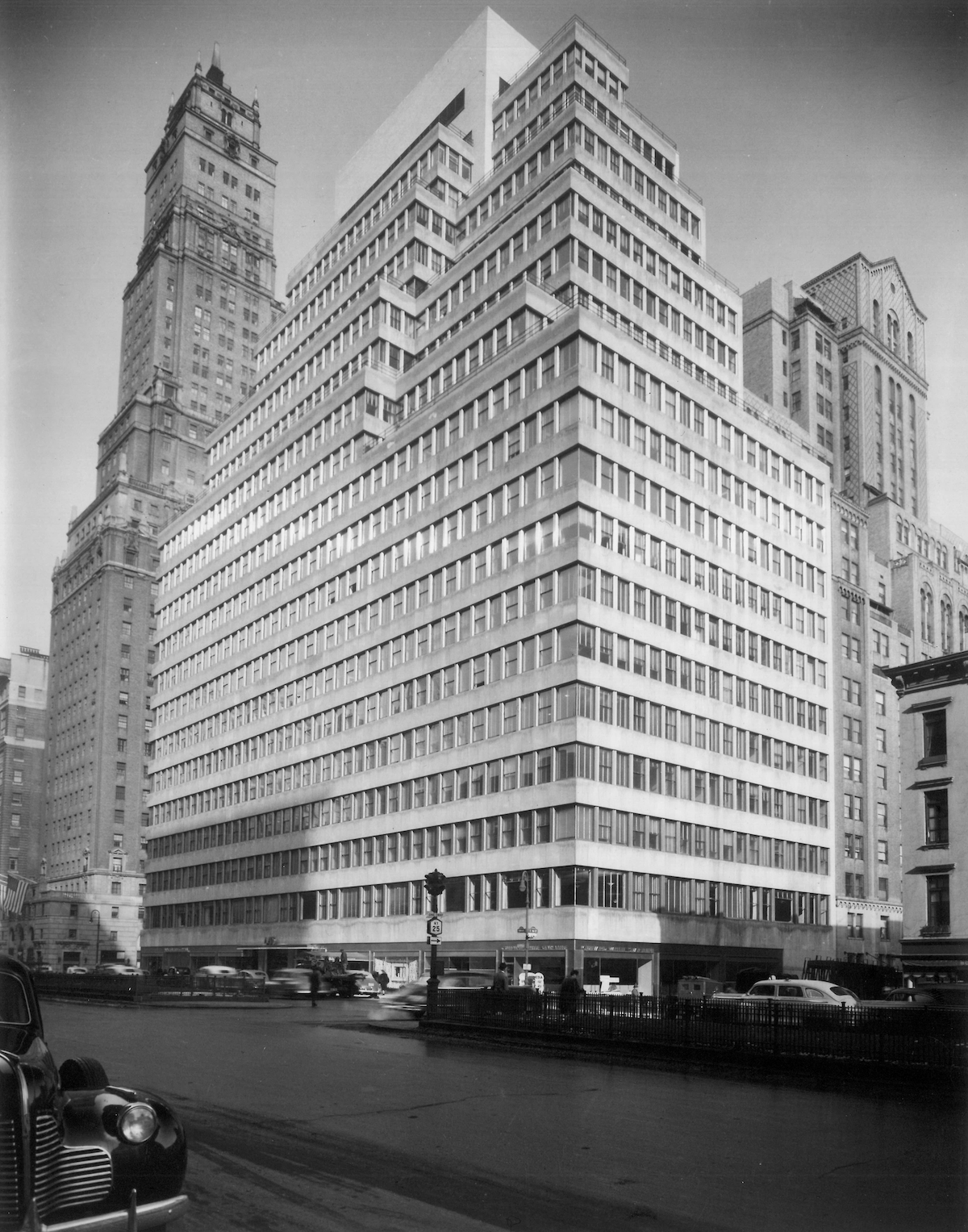
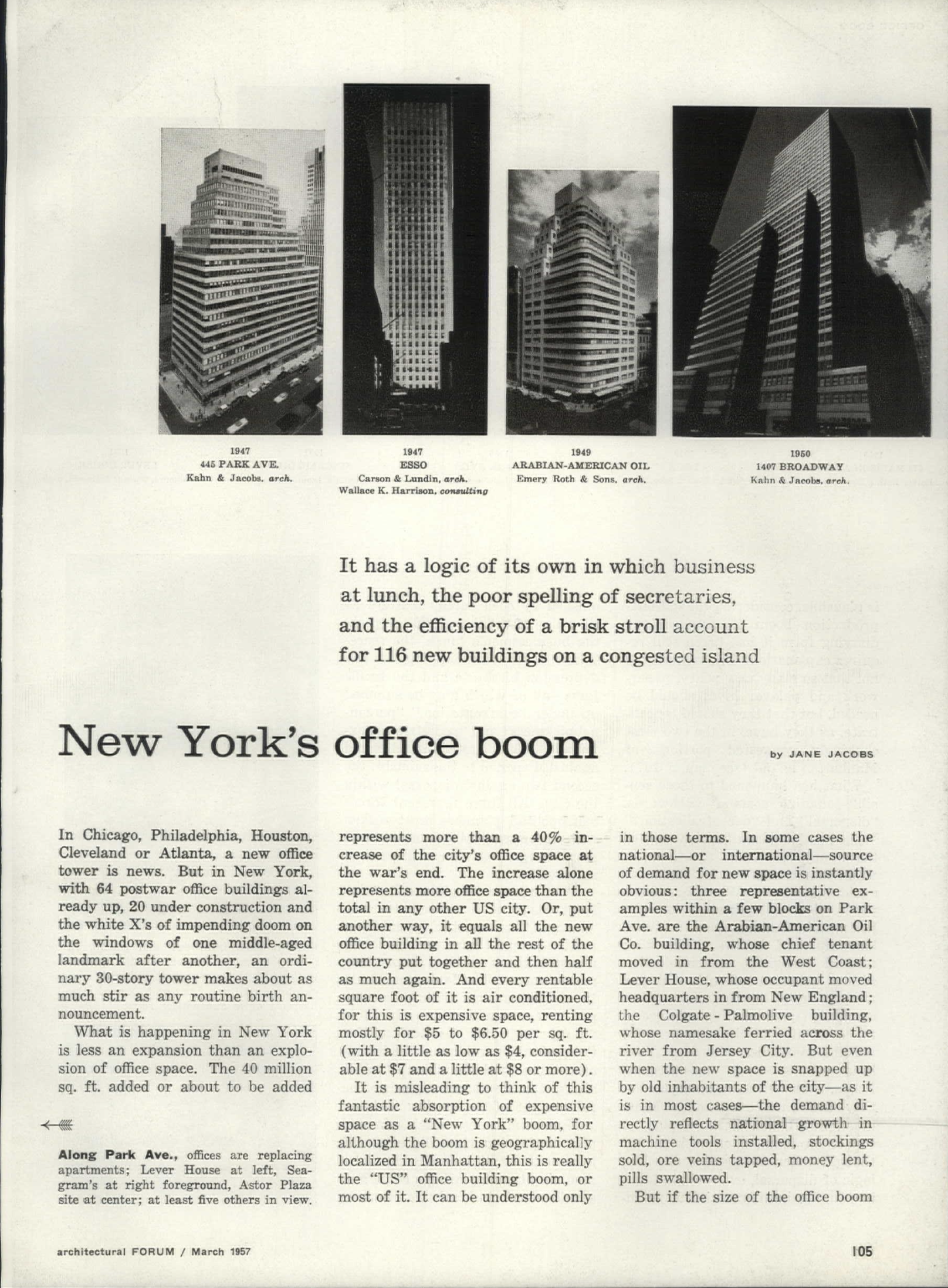
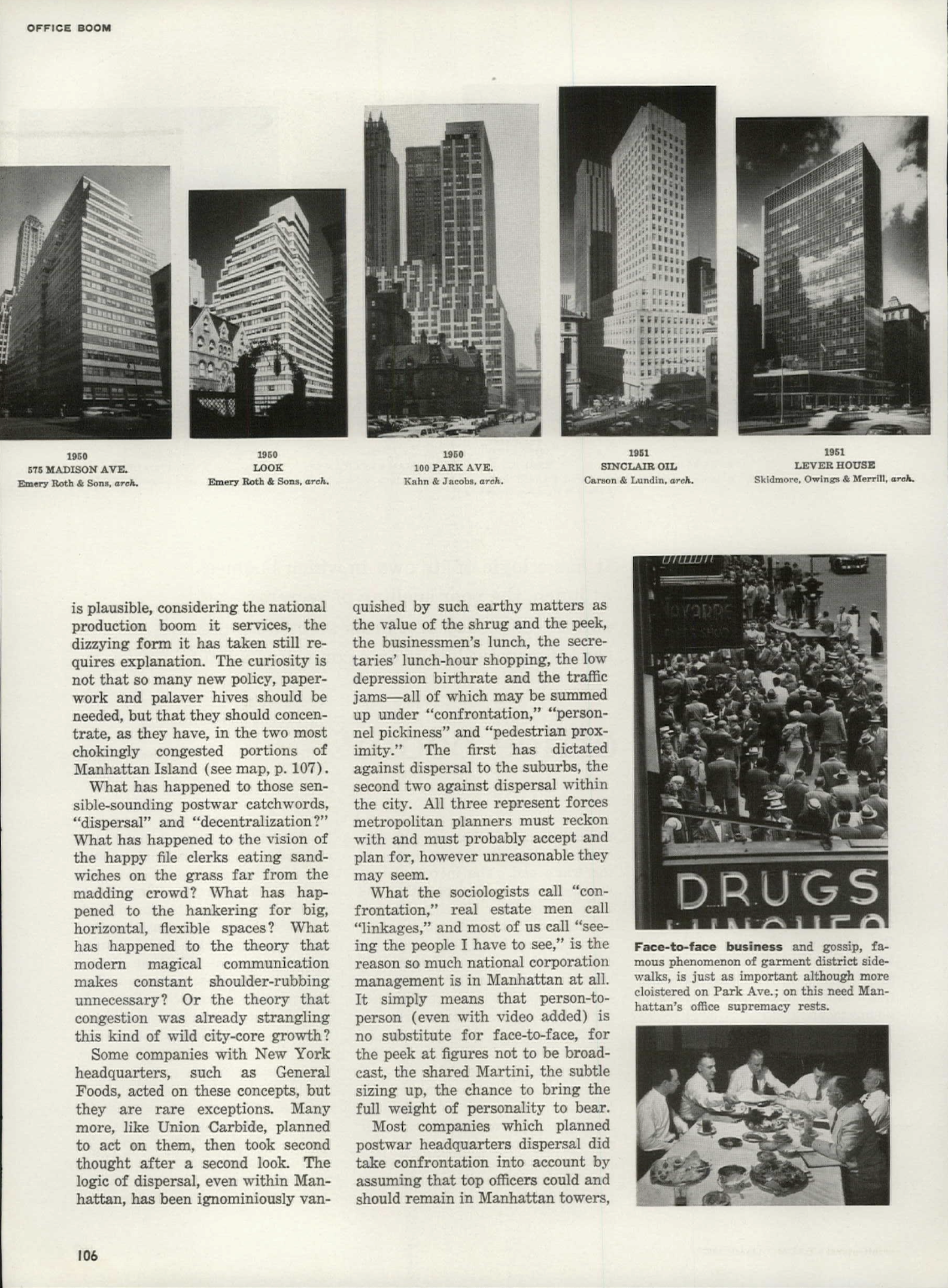
The first wave of postwar office construction began on Park Avenue in 1947 with the completion of the 22-story 445 Park on the southeast corner of 57th Street, a Modernist mid-rise by the architects Kahn & Jacobs. In the following decade, New York experienced a boom in office buildings that paralleled the skyscraper frenzy of the late Twenties. By 1957, as Jane Jacobs detailed in her Architectural Forum article, "New York's Office Boom," Manhattan had already raised 64 new office towers, had another 20 under construction, and had more than 30 more announced.
Until 1961, when the city's zoning law changed to limit the maximum Floor Area, rather than prescribe a 3-D "envelope," most of the new high-rises were speculative projects and conformed to the space-maximizing, setback formula of the 1916 zoning law. A few architectural firms – especially Emery Roth & Sons and Kahn and Jacobs – dominated the market.
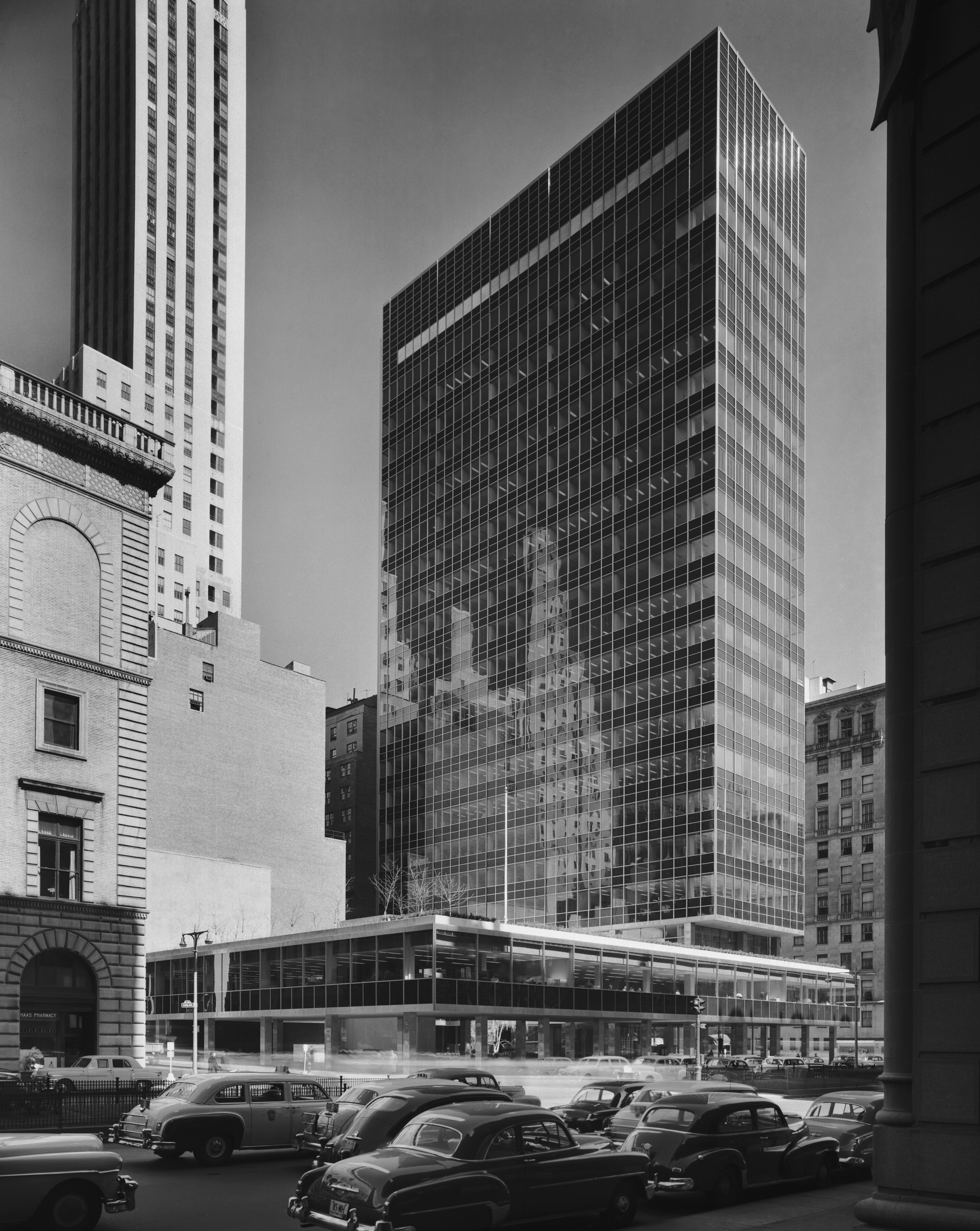
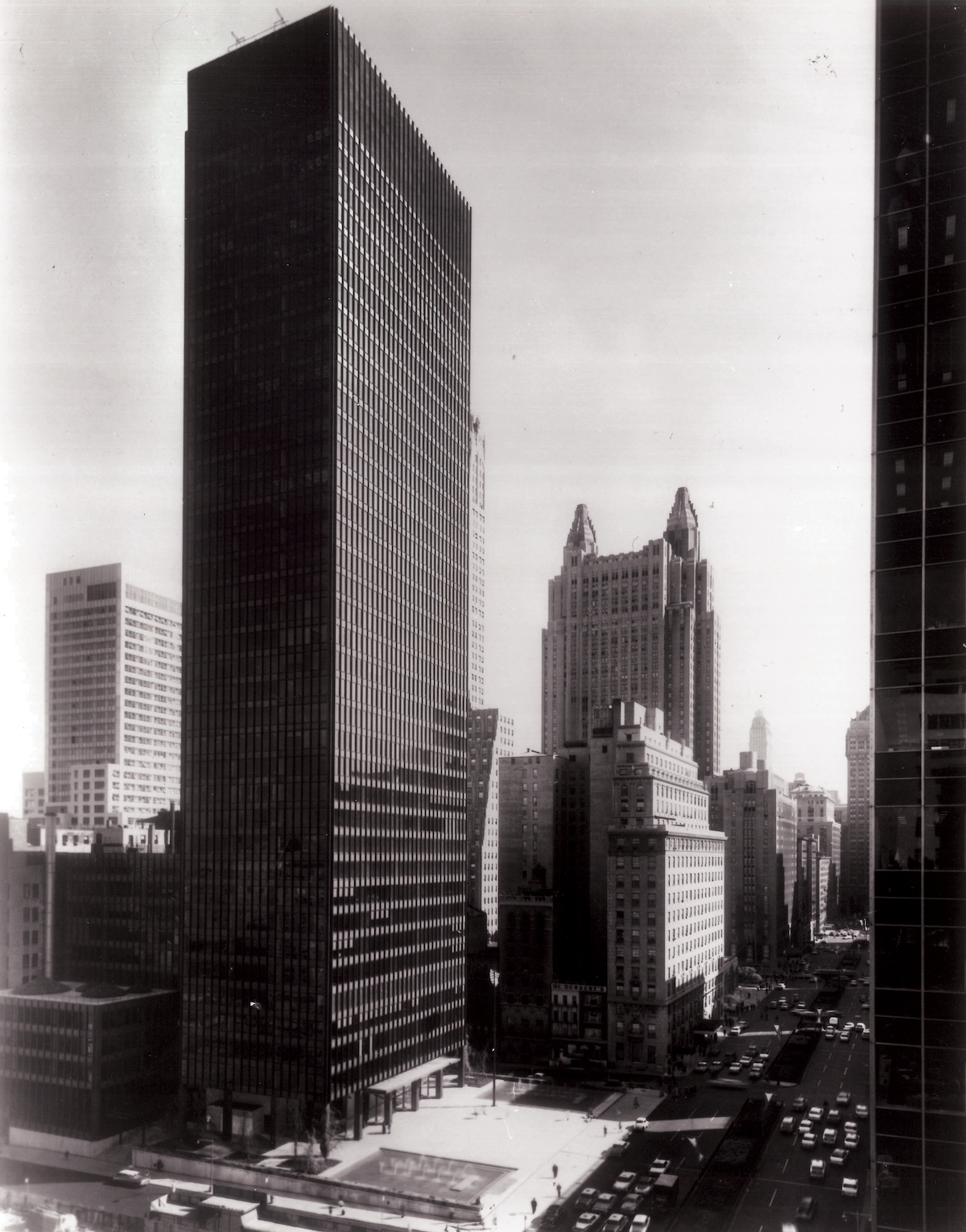
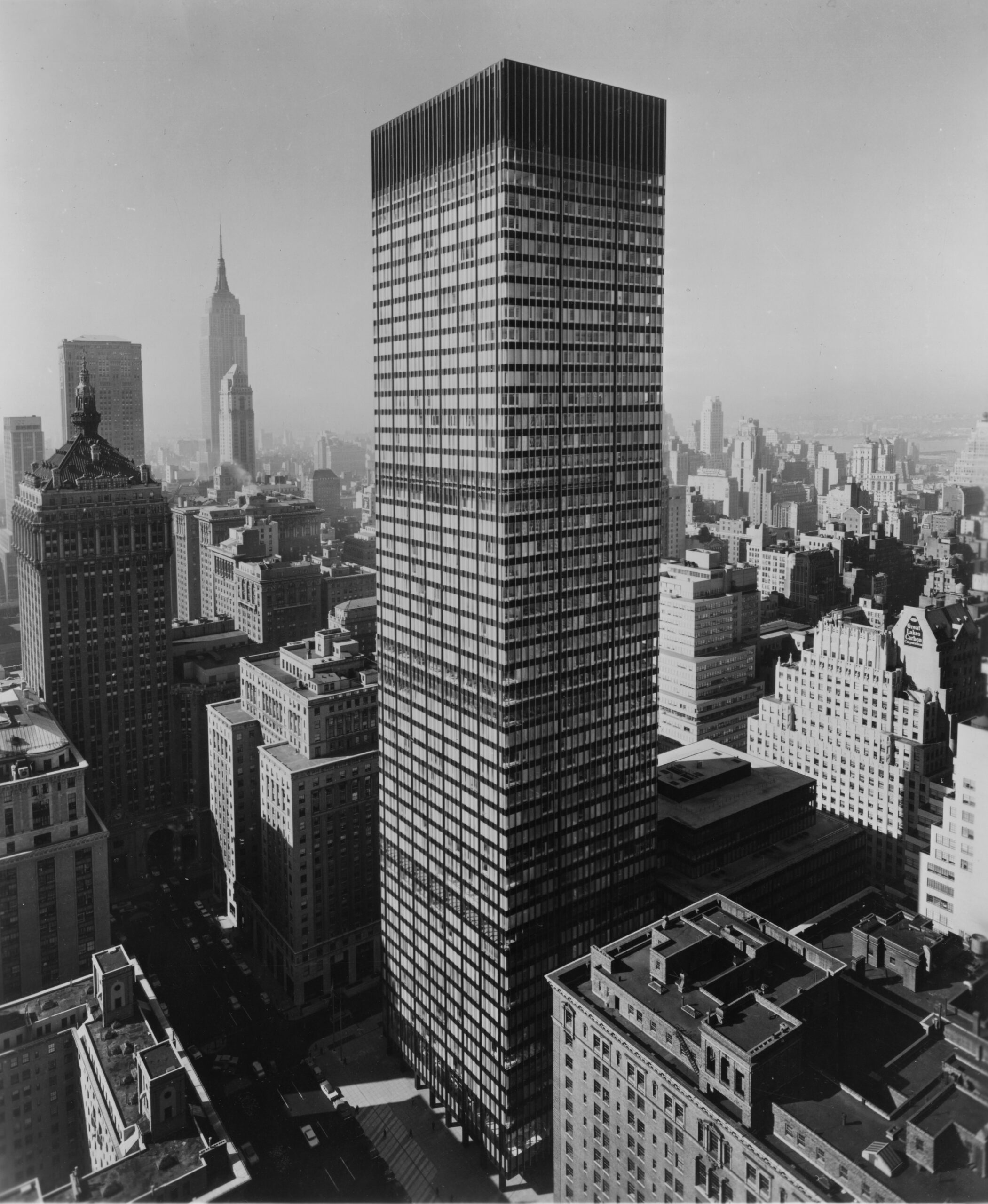
Notably, though, during these same years, the corporate headquarters for Lever House, the Seagram Building, and Union Carbide proposed an alternative model. All three expressed Modernism’s penchant for presenting the building as a simple form, free-standing and surrounded by open space. Unlike all the previous structures of Terminal City, these towers did not rise up from the edge of their lot, but were set back in a plaza or turned perpendicular to Park Avenue, breaking the continuity of the street wall that for more than three decades had defined Park Avenue. Their examples influenced the changes effected in the new 1961 zoning law.
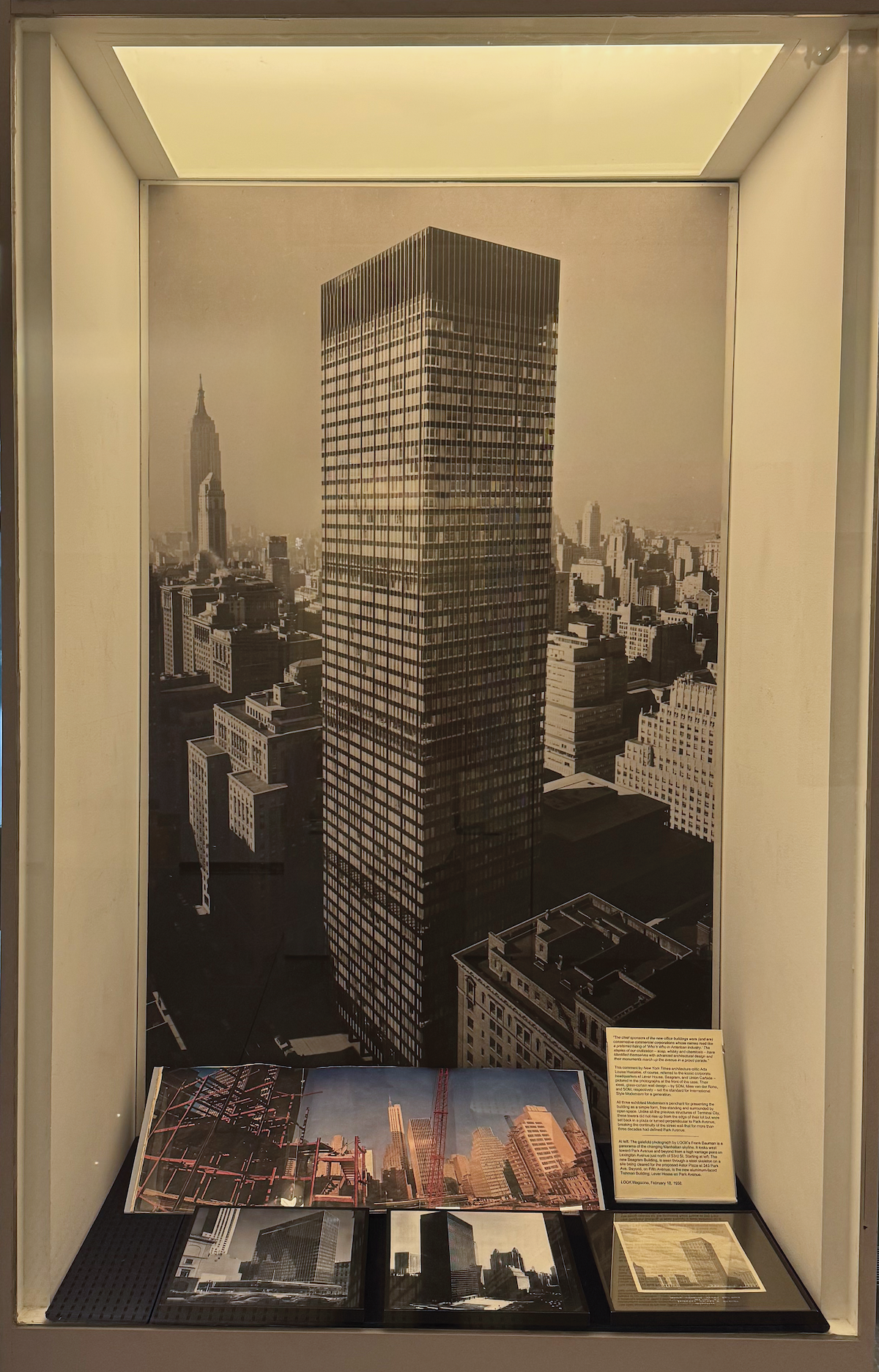
The gatefold photograph by LOOK’s Frank Bauman is a panorama of the changing Manhattan skyline. It looks west toward Park Avenue and beyond from a high vantage point on Lexington Avenue just north of 53rd St. Starting at left: The new Seagram Building, is seen through a steel skeleton on a site being cleared for the proposed Astor Plaza at 345 Park Ave. Beyond, on Fifth Avenue, is the new aluminum-faced Tishman Building; Lever House on Park Avenue. LOOK Magazine, February 18, 1958.
CORPORATE HEADQUARTERS
“The chief sponsors of the new office buildings were (and are) conservative commercial corporations whose names read like a preferred listing of ‘Who’s Who in American Industry.’ The staples of our civilization – soap, whisky and chemicals – have identified themselves with advanced architectural design and their monuments march up the avenue in a proud parade.”
This comment by New York Times architecture critic Ada Louise Huxtable, of course, referred to the iconic corporate headquarters of Lever House, Seagram, and Union Carbide. Their sleek, glass-curtain wall design – by SOM, Mies van der Rohe, and SOM, respectively – set the standard for International Style Modernism for a generation.
Completed in 1952, Lever House was the city’s first true “curtain wall” skyscraper – a simple rectangular slab clad in a taut skin of greenish glass. Lead design partner of the New York office of SOM, Gordon Bunshaft, alternated vision glass with horizontal bands of a darker green that disguised the floor slabs and complied with current fire codes. The overall effect was a gleaming surface that mirrored the surrounding buildings while also revealing the structure within. Lifted up from the street on piloti columns, the tower – which rose above only a quarter of its elevated base – expressed lightness, especially in contrast to its masonry neighbors. As the corporate headquarters for one of the country’s largest detergent and soap manufacturers, the squeaky-clean glass box was a fitting brand advertisement for their products.
Likewise, the Seagram Building, completed in 1958, was designed to project an image of its owner company, the liquor distiller and marketer Joseph E. Seagram & Sons. The selection of the architect — the German-born, but Chicago-based Mies van der Rohe — was a declaration of high-brow taste that carried the endorsement of the Museum of Modern Art and its curator of architecture Philip Johnson, who also collaborated with Mies on elements of the design. The shape of the building was a straight-up tower set back ninety feet from the street on a travertine podium, flanked by reflecting pools. The color of the facade was a deep brown, both in the bronze-tinted windows and the famous mullions in the form of an I-beam that ran the full vertical height in front of the glass to cast shadows that darkened and enriched the surface.
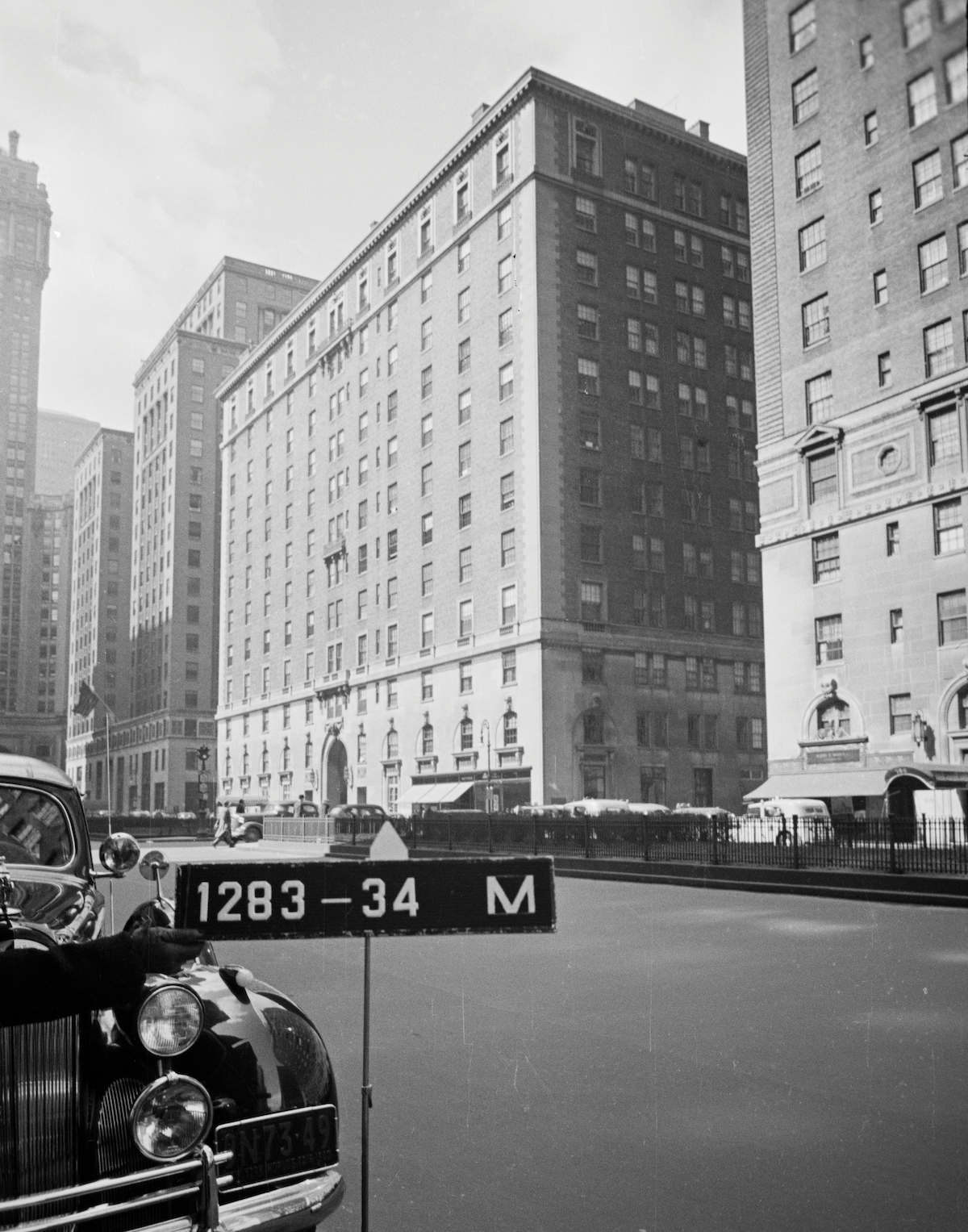
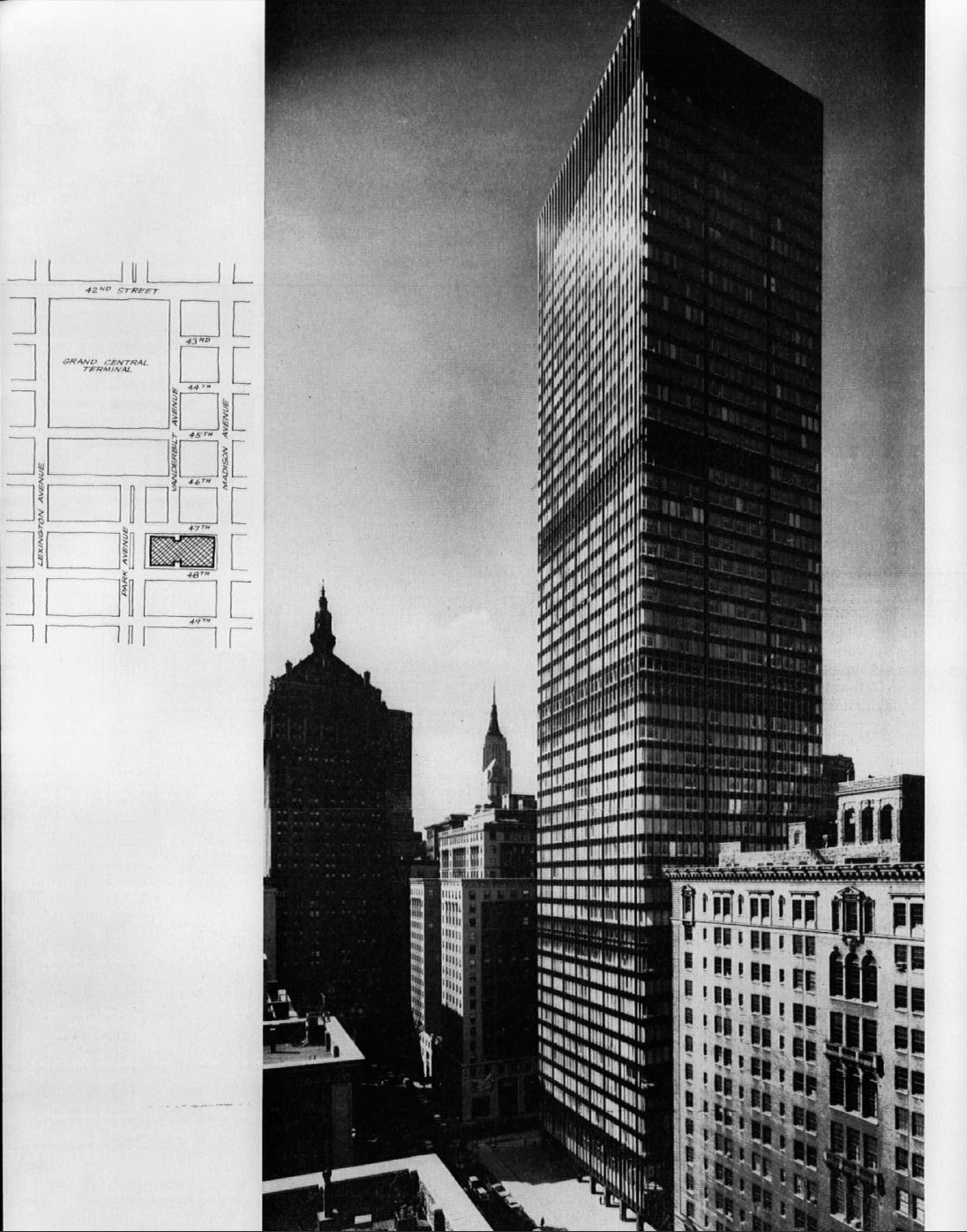
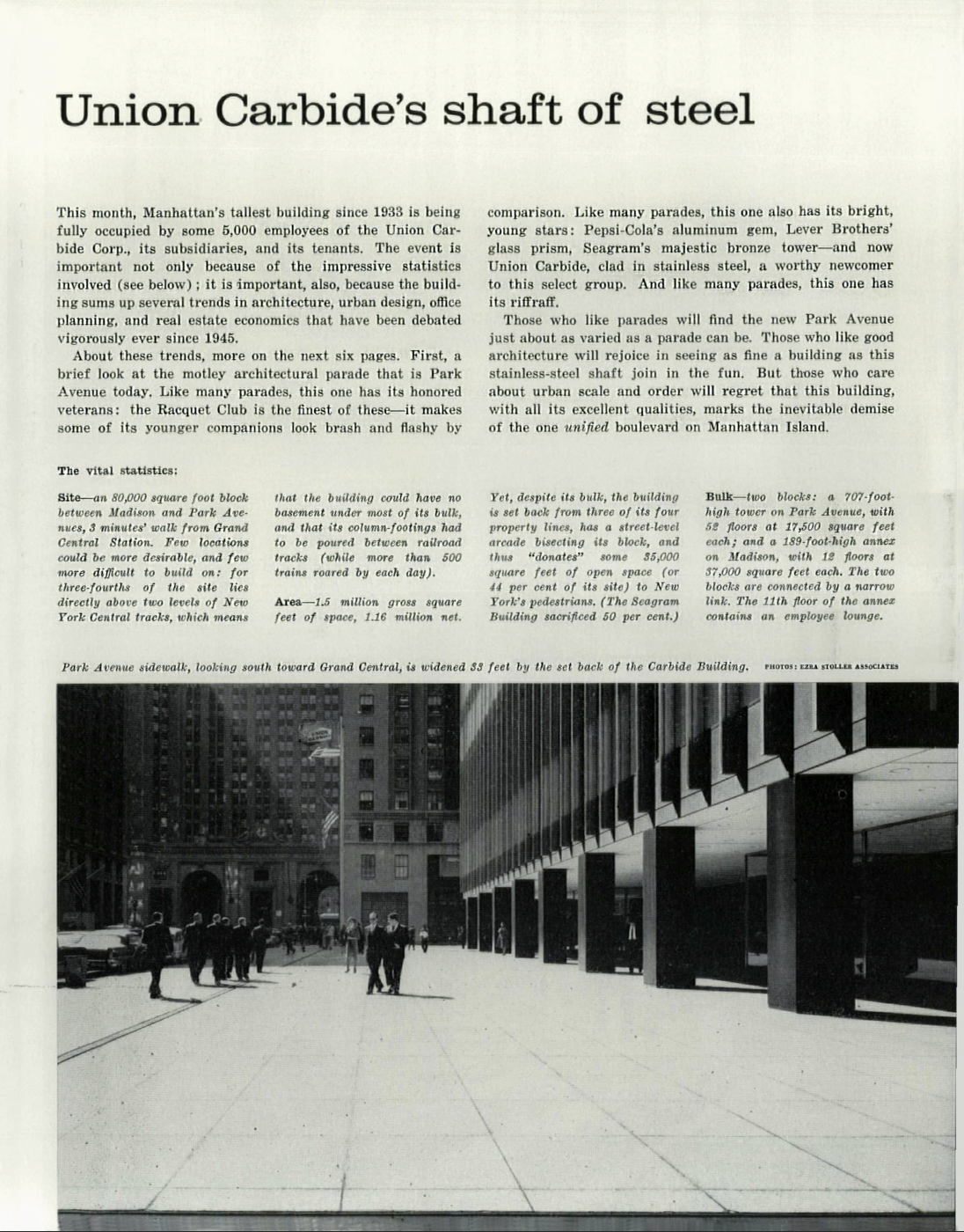
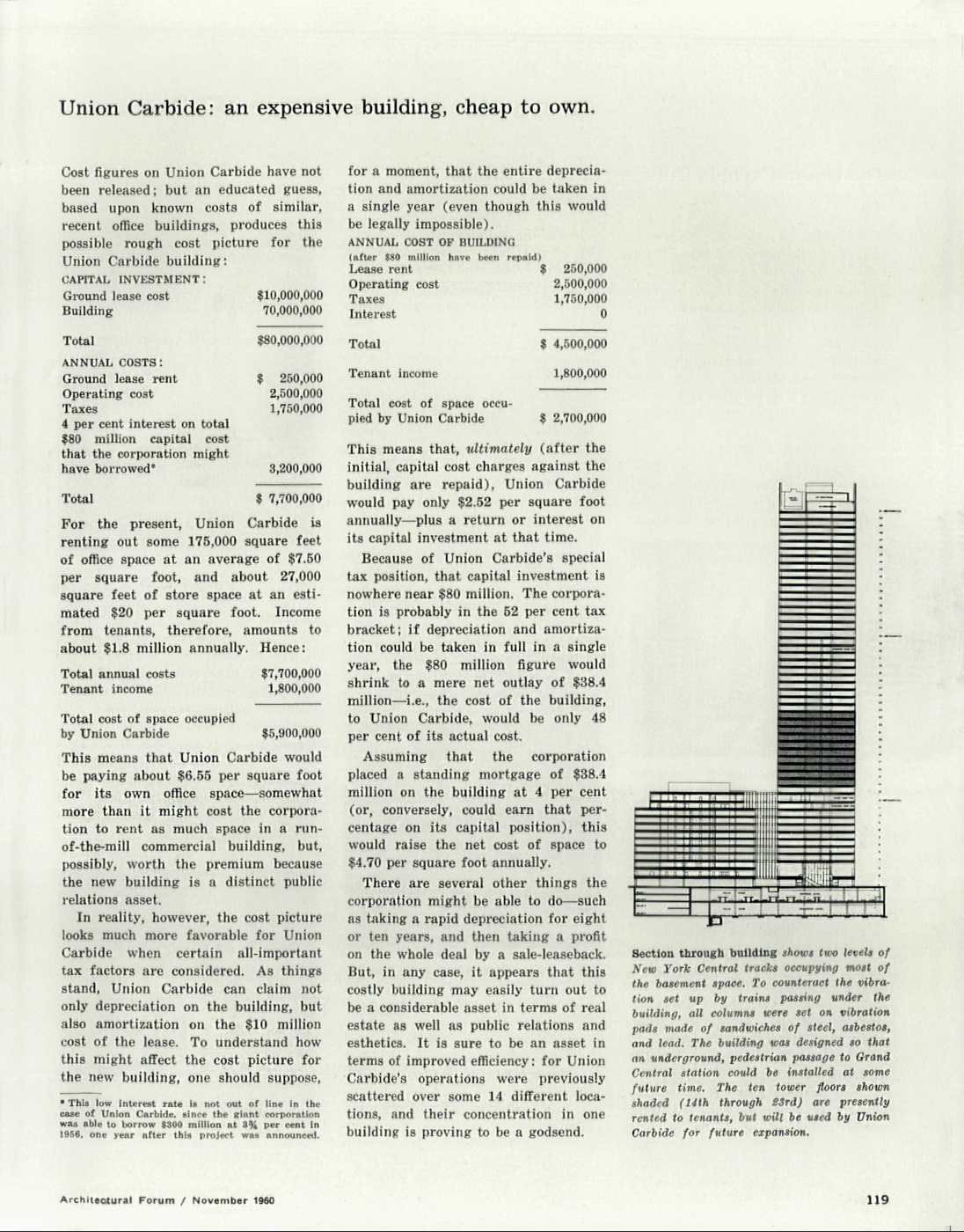
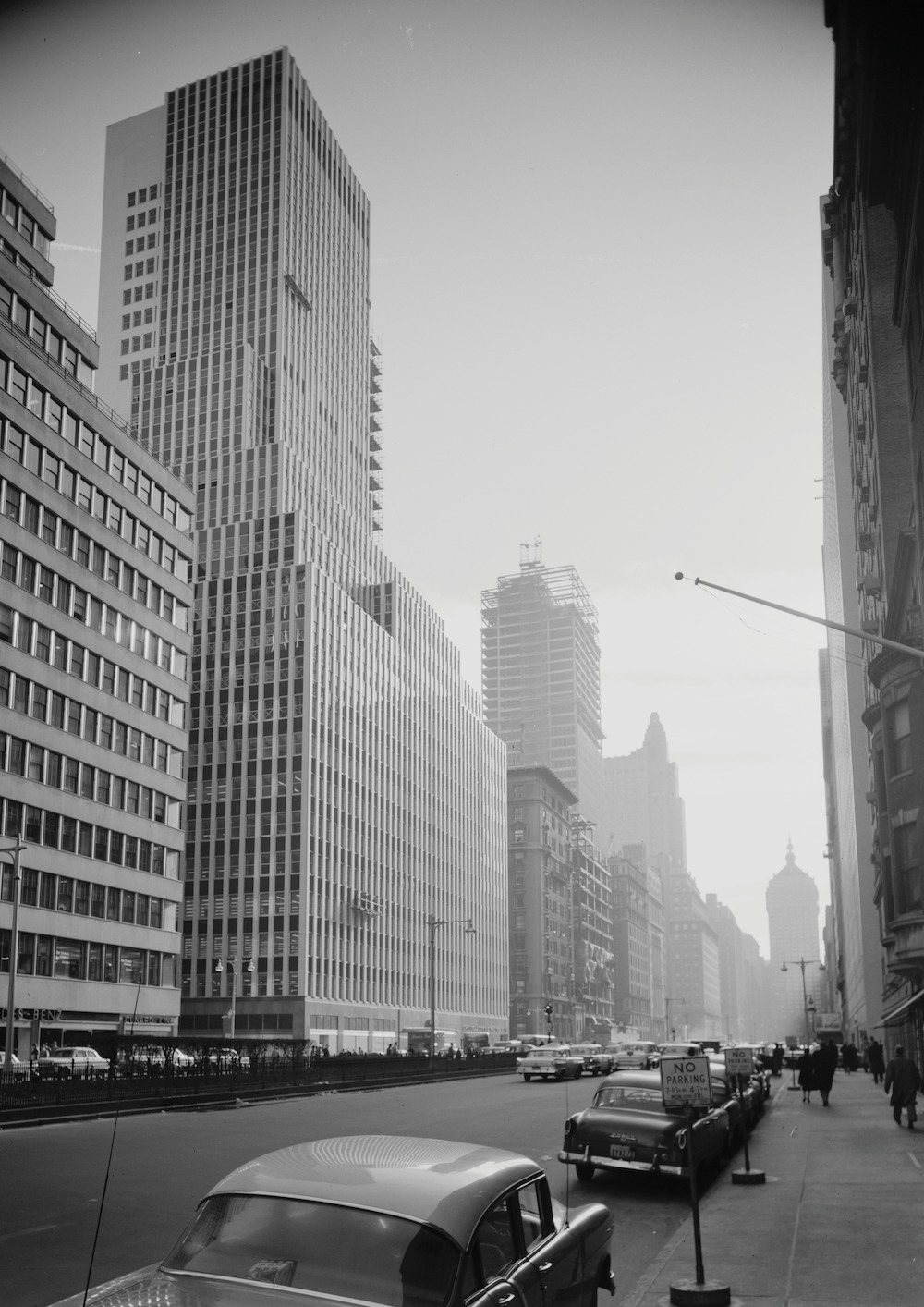
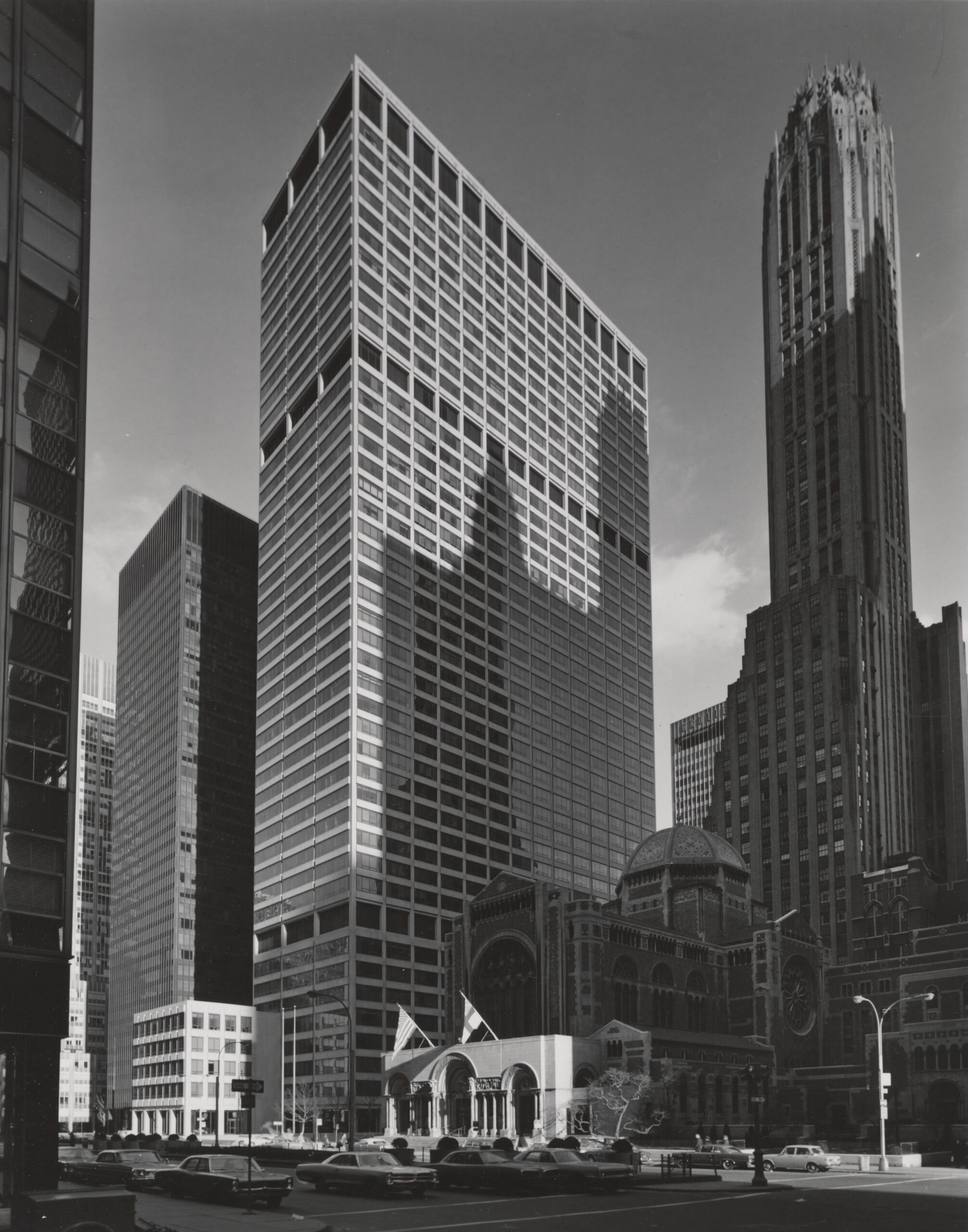
Another SOM essay in tailored corporate modernism was the Union Carbide Building, completed in 1960. A sheer glass tower, rising 707 feet, caged in a lattice grid of stainless steel, it was the tallest skyscraper on Park Avenue to date. The rational system of a 5-foot module was dictated by the column spacing of the railroad tracks it spanned and was reflected on the bays of fenestration, as well as the office layouts. As the chemical company’s U.S. headquarters, the building housed 5,000 employees in its 52 stories, and because the project occupied the full area from 48th and 49th Street and Park to Madison, the western section of the block was developed with a shorter annex of 12 floors. To erect the skyscraper, the Marguery Hotel and Apartments – which were completed in 1917 and were among the earliest of the stately residential buildings in the district – were demolished. The Union Carbide Building itself was taken down to create the site for the new global headquarters of JPMorgan Chase Tower.
A 1960 Architectural Forum article on Union Carbide fully illustrates the contrasts between the old and new Park Avenue. All three towers exhibited Modernism’s penchant for presenting the building as a simple form, free-standing and surrounded by open space. Unlike all the previous structures of Terminal City, these towers did not rise up from the edge of their lot but were set back in a plaza or turned perpendicular to Park Avenue, breaking the continuity of the street wall that for more than three decades had defined Park Avenue.

1961: A NEW ZONING LAW
New York’s 1916 zoning law, with its characteristic setback form, governed the development and design of skyscrapers until 1961, when a new code was implemented that changed the basic concept of how the city regulated the height and bulk of high-rise buildings. Rather than limiting the overall shape, or “envelope” of the building, the new code set a maximum amount of floor area in relation to the size of the lot, that is, a floor-area ratio, or FAR. Substantially more restrictive than the 1916 law, the 1961 code effectively “down-zoned” high-rise buildings across the city.
For more than a decade, planners and reformers had been calling for a modern formula that would reduce bulk, limit overall floor area (and thereby height), and create open space at sidewalk level. The drawings by the architectural delineator Hugh Ferriss, at left, show some of the early options studied for the new code. Under the 1961 law, towers were generally allowed to cover a maximum of 40 percent of the zoning lot area. Influenced by the gracious plazas of Lever House, Seagram, and Union Carbide, planners sought both to codify open space and to create incentives for larger privately-owned public space (POPS).
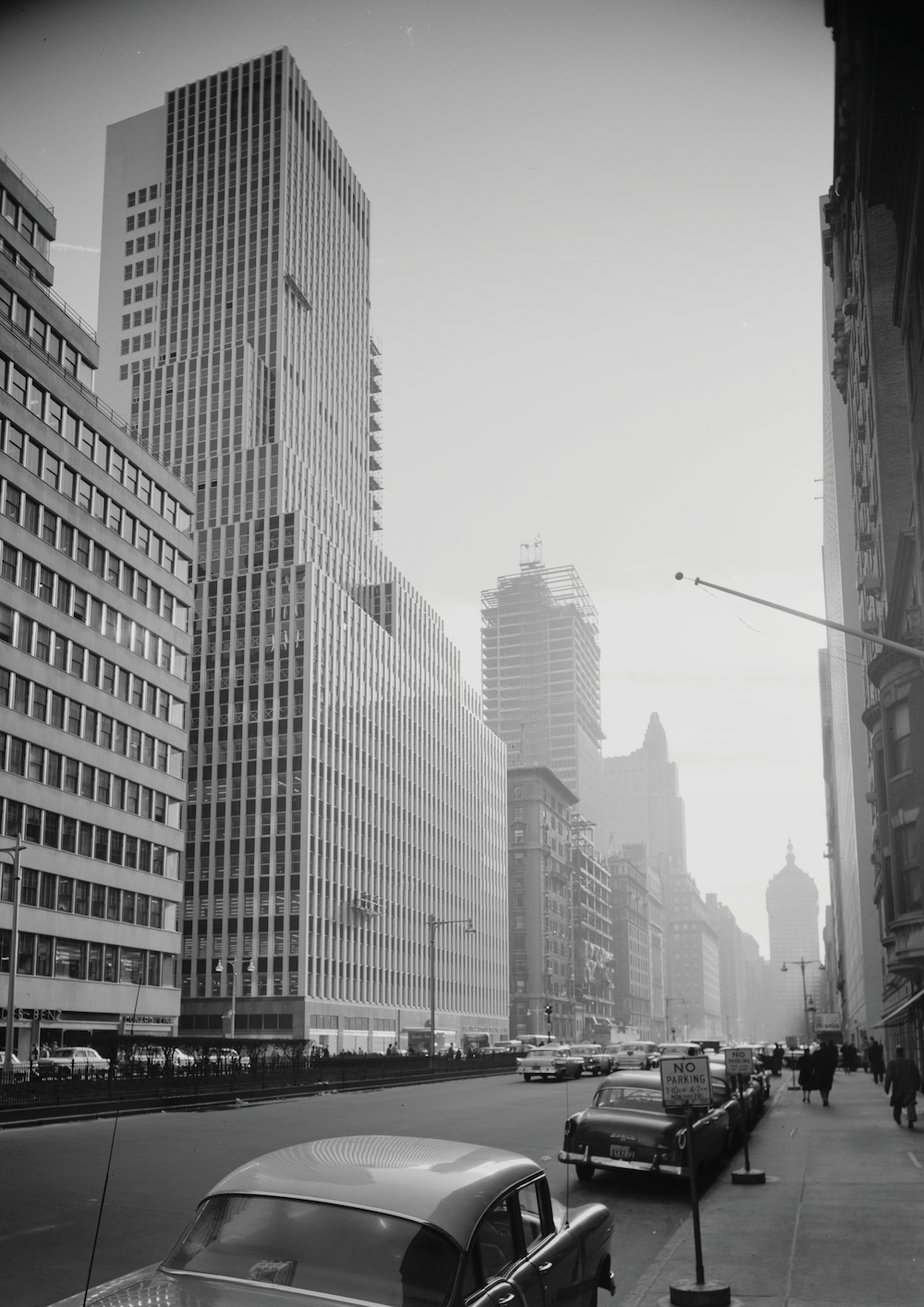
The photographs of the 1957 setback high-rise at 425 Park (replaced in 2021 by the new Norman Foster-designed tower) and the 1969 skyscraper at 345 Park illustrate the “before and after” of the standard zoning-law formulas as implemented.
PAN AM BUILDING
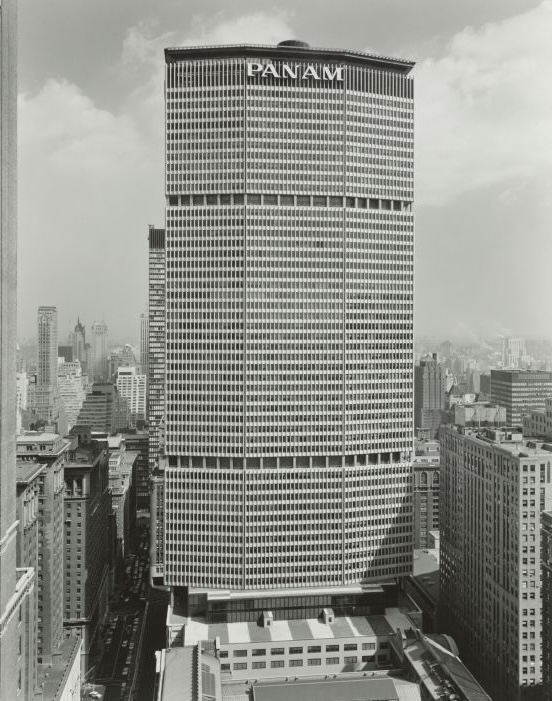
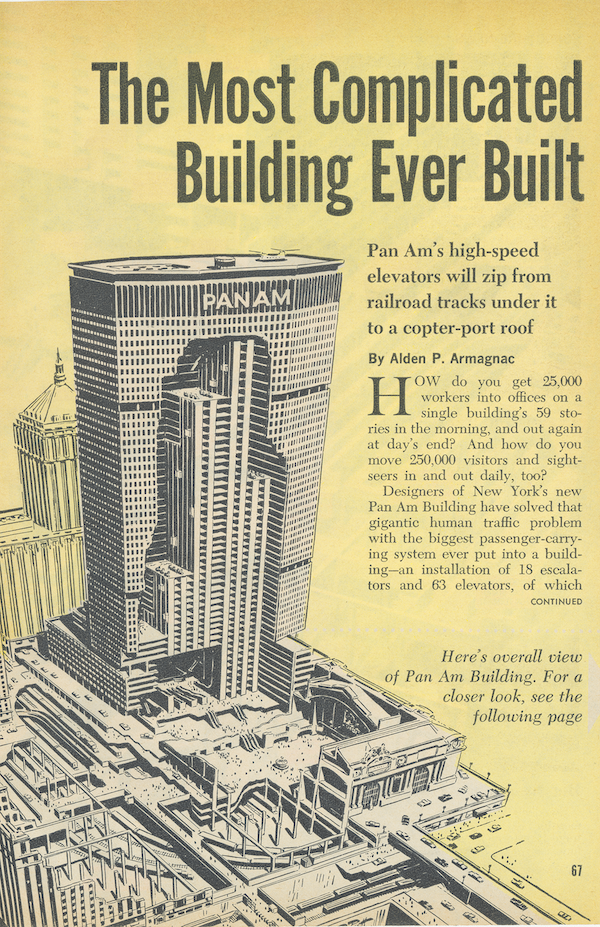
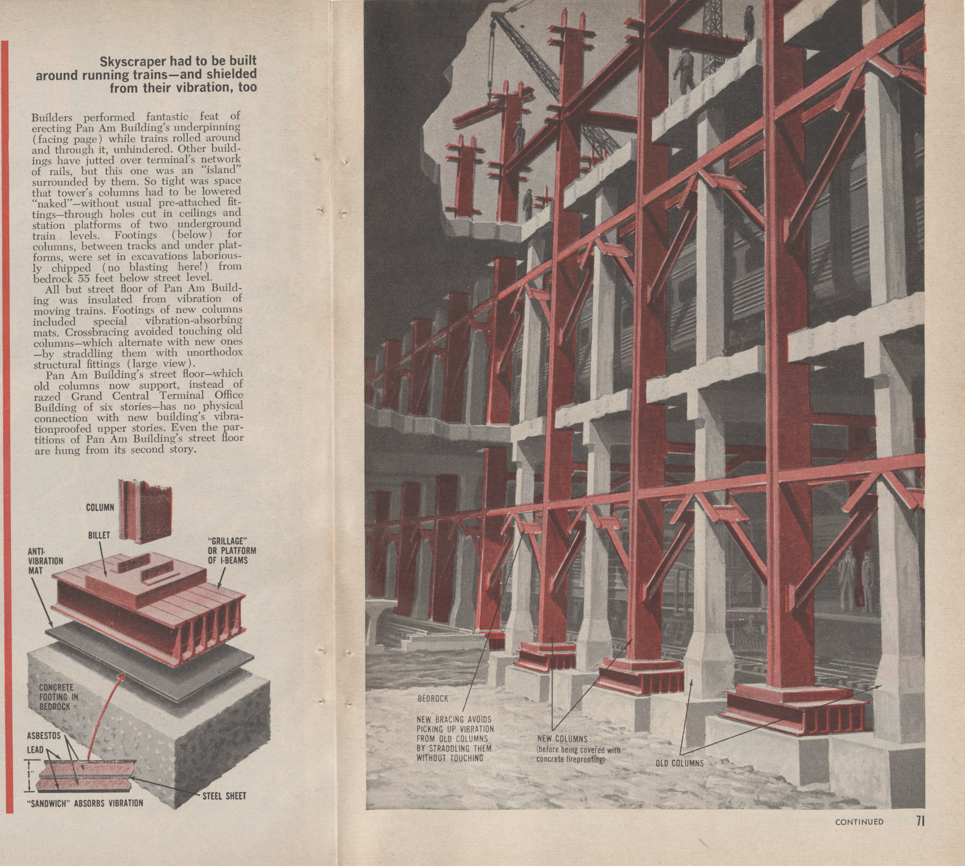
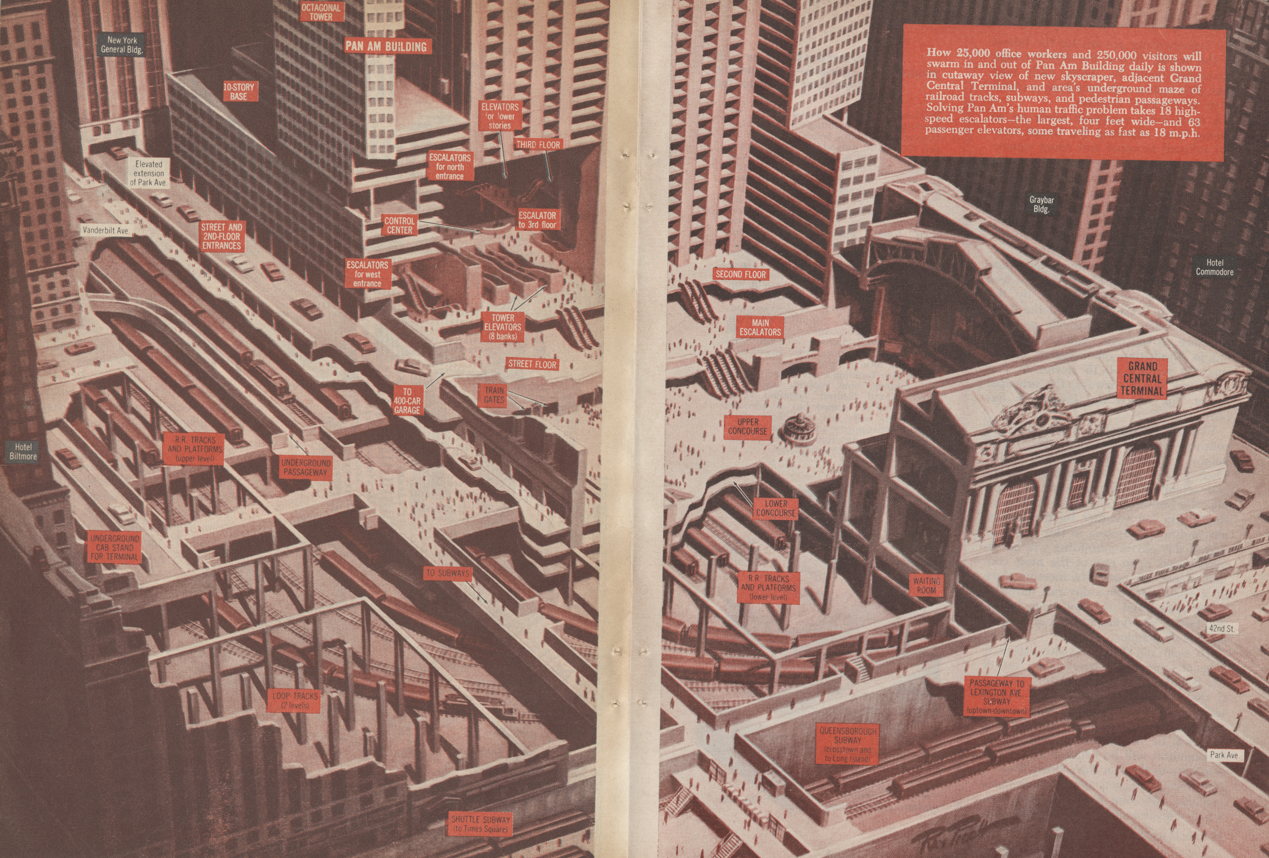
Sandwiched between the 1913 Grand Central Terminal and the 1929 New York Central Building, the Railroad’s skyscraper headquarters, the Pan Am Building – now known as the Met Life Building or 200 Park Avenue – represented the last act of the Central’s 1903 plan to apply real estate revenues to fund its investments and operations. When completed in 1963, the massive slab of Pan Am rose 808 feet and packed 2.8 million sq. ft. of floor space into its 59 stories to become the world’s largest commercial office building.
Constructed mid-block and aligned with 45th Street, even the tower’s thin side interrupted the open slice of sky looking crosstown on the grid. But far more significantly, Pan Am’s wall-like width consumed the once-soaring silhouette of the New York Central (now, Helmsley) Building and destroyed the dramatic vista of the original Terminal City ensemble from Park Avenue.
After several early proposals in the mid-1950s, including I. M. Pei’s 1,700 ft. twisting structure, the “Hyperboloid,” the speculative developer Erwin Wolfson leased the site and worked through several schemes and teams of architects. In 1958, Wolfson paired Emery Roth & Sons with Walter Gropius, founder of the Bauhaus, and engineer Pietro Belluschi. The high-profile European modernists envisioned the elongated octagon with a façade of precast concrete and banded windows that emphasized horizontals, not height.
Pan Am was highly controversial in its time. As historian Meredith Clausen, author of The Pan Am Building and the Shattering of the Modernist Dream, noted: “The building was despised from the moment the plans for the mute, massive, overscaled octagonal slab were announced.” Gropius vigorously defended his work, stating that the building solved the issue of “changing relationships in the sizes and dimensions of building mass in cities.” To him, this new scale was needed to serve the city of the future. But as Clausen further assessed from her book’s distance of 2004, the skyscraper marked “the acme of modernism and its demise.”
The Pan Am Building — named for its anchor tenant, the now vanished airline — was the result of the Railroad’s search for real estate revenue that would support their declining traffic and fortunes. In 1968, the New York Central and the failing Pennsylvania Railroad would merge, only to declare bankruptcy in 1970. In 1982, the Metropolitan Transportation Authority (MTA) rescued the commuter rail network and in March 2020, became the official owner and operator of the great Grand Central Terminal.
AERIAL VIEW OF POSTWAR PARK AVE.
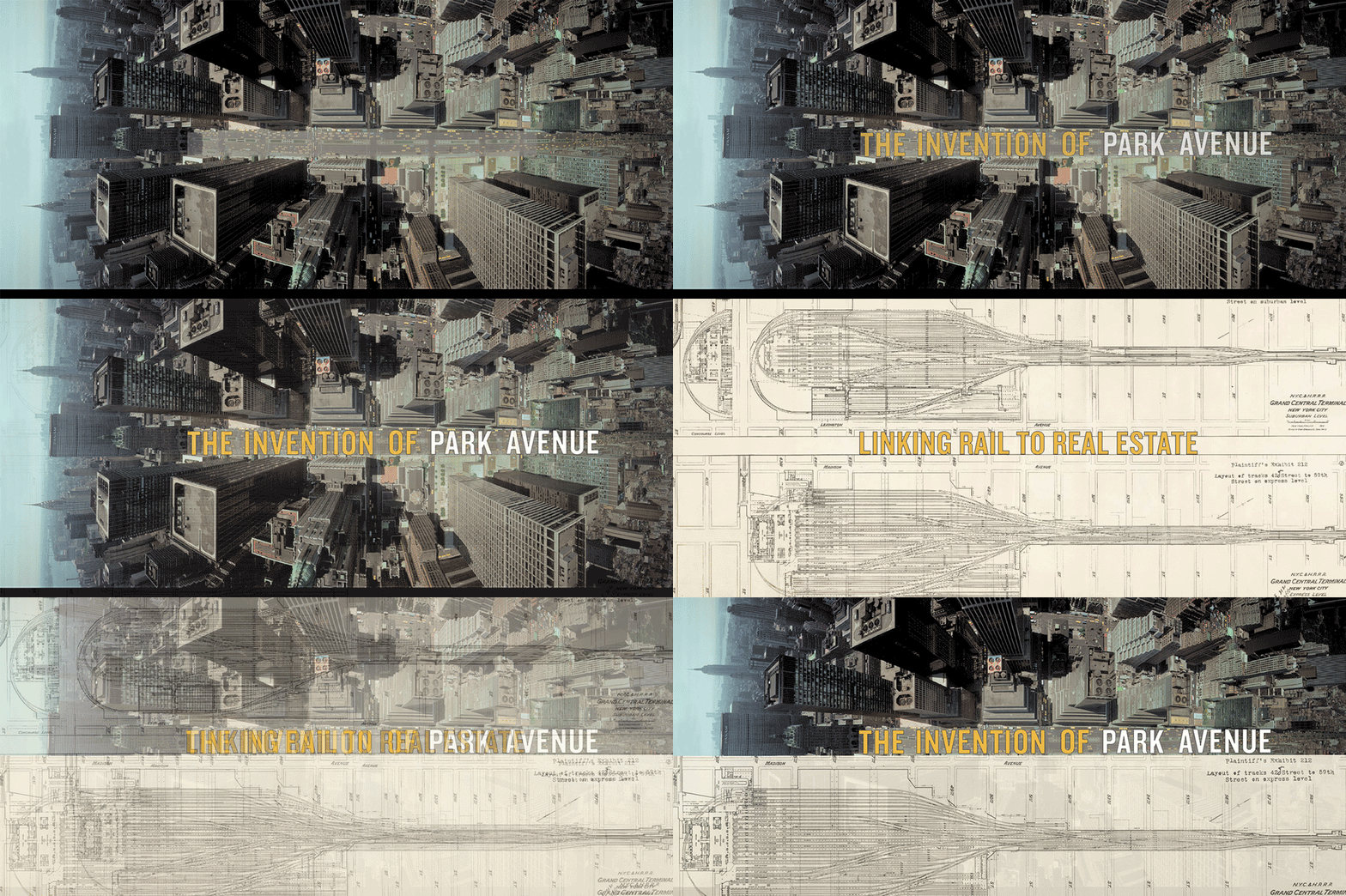
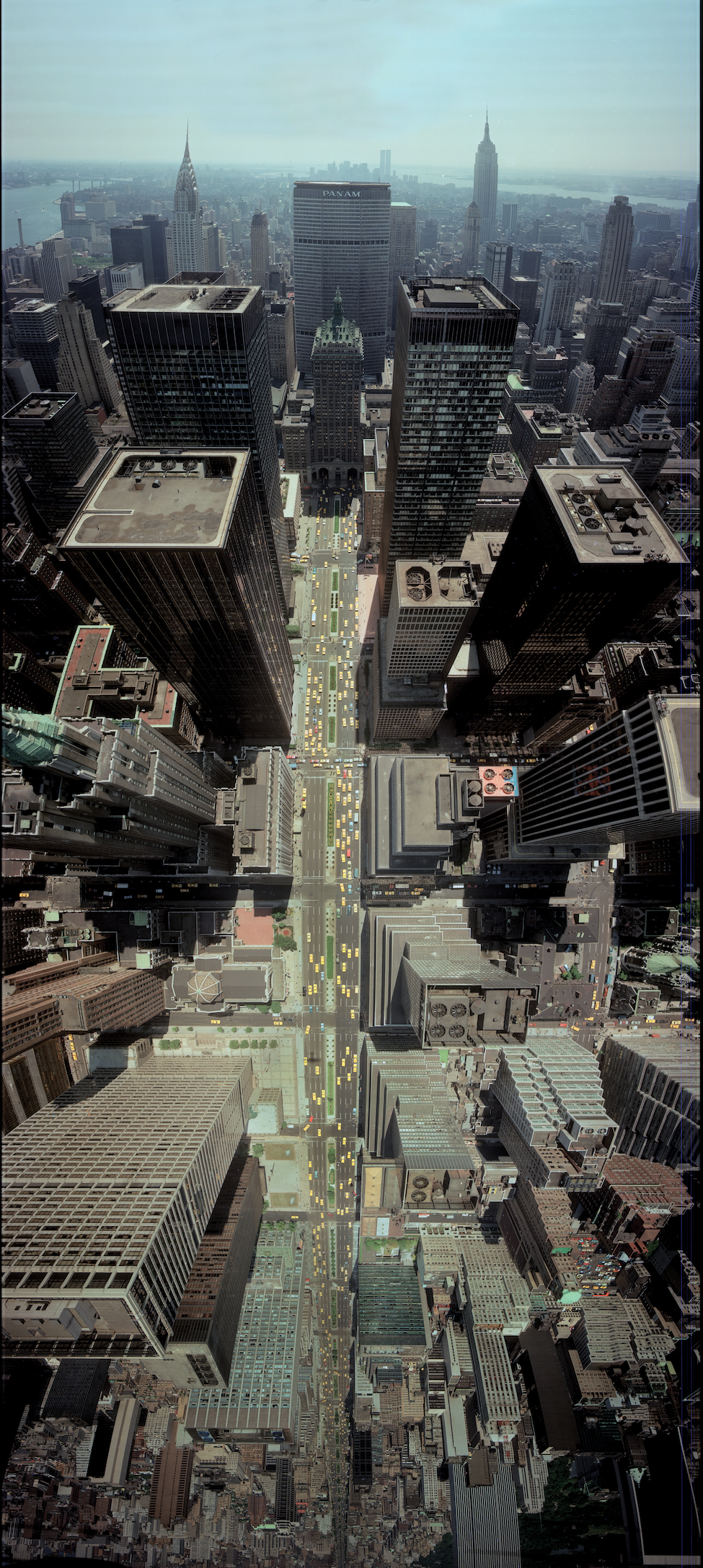
The aerial panorama above and enlarged on the adjacent wall is a stunning summary of the postwar development of Park Avenue by the mid-1970s. At the top of the image, looking south, the New York Central and Pan Am buildings close the Park Avenue vista. Beyond are the Chrysler Building, Empire State, and way downtown, the Twin Towers of the World Trade Center.
This vertiginous view, from high in the air directly above 50th Street, was captured by the photojournalist Howard Sochurek (1924-1994). It shows every block built on and a mix of prewar and postwar buildings. The sweep of this sky view makes clear that the scale of postwar modernist towers was growing steadily taller.
The first postwar wave of construction, which began in the late 1940s and continued through the early 1960s, followed the mandates of the 1916 zoning law. The three buildings at the center of the photo – 300, 320, and 350 Park Avenue, all designed by Emery Roth & Sons – used a stacked, setback massing and rose to about 300 to 425 feet tall. During these same years Lever House, the Seagram Building, and Union Carbide proposed the shear slab tower set in a plaza as an alternate model to what the zoning law required. Their examples influenced the massing changes in the new 1961 code.
In 1963, the Union Carbide headquarters and the just-completed Pan Am Building were the tallest structures in the district at 52 and 59 stories, but by the late Sixties, 40 to 50 stories were standard. Prominent in the Sochurek photo are 277, 299, and 345 Park Avenue, built from 1963 to 1969. Although shorter than Union Carbide and Pan Am, these mid-Sixties buildings rose higher than the earlier setbacks and represented the new popularity of the slab formula.
Aerial photograph of Park Avenue, reproduced from the original negative image, by Howard Sochurek, c. 1975. Howard Sochurek photographic archive, camh-dob-040405, The Dolph Briscoe Center for American History, The University of Texas at Austin. Courtesy of the Howard Sochurek Estate